Thursday, December 22, 2011

Season's Greetings


And so 2011 and the first six months in the life of the Period Drama King blog are coming to an end. All that remains is to have a go at the first annual end-of-year quiz, catch all the goings-on in Downton Abbey, Satis House and 221b Baker Street over the holiday season, look forward to the many delights coming our way next year (starting with Birdsong on the Beeb in January, pictured above) and generally have a merry old Christmastime. I have been thrilled by the fledgling success of this record of my various scribblings and musings and I'd like to thank all those who have supported this enterprise particularly the academic, the vicar, the forensics expert, the coolest couple in town, the Englishwoman, the Belgian, the lawyer, the emigrant, the jester, the blonde, the teachers, the first Mrs Bates and, last but by no means least, the muslin enthusiast. All I can do in gratitude is promise that wherever people are being dramatic in a time other than our own, I shall continue to be there. Period.

Sunday, December 18, 2011

The Lavinia Swire Period Drama Quiz 2011


1. In the Upstairs Downstairs revival, the cook Mrs Thackeray was relieved to discover that who was to be called George?

2. What was done by firelight in 1969 and on a beach in 2011?

3. "Do you remember the game we used to play when you were a baby? On the coldest winter nights, I'd creep into your room while you were sleeping, all cuddled up in your blanket, and I'd pull it off. Do you remember? I'd pull it off and I'd say that's what God does. That's what God does." Name the mini-series.

4. Tipping the Velvet. Fingersmith. Affinity. What's next in the sequence and why?

5. What did Cary Fukanaga and Andrea Arnold both do this year?

6. The distinguished television director John Howard Davies, who died in August, first found fame as a child actor. What iconic role did he play in 1948?

7. Hattie (pictured above) was a drama based on the life of comedienne and actress Hattie Jacques and depicted, amongst other events, the making of which movie in the Carry On franchise?

8. I have wooed Fanny Brawne, befriended Charles Ryder and been obsessed with scent. Lately, I've decided that the newsreels are dead. Who am I?

9. Headmistress Sarah Burton upsets herself by reflecting on the sacrifice made by her late, lamented intended whilst Lady Mary realises that Captain Crawley has not been killed in action but is very much alive and kicking. What's the connection?

10. In which recently-released period film would you encounter the stoical Mrs Elton, her dilapidated boarding house and its colourful inhabitants?

11. The celebrated actress Margaret Tyzack, who died in June, starred as Soames's sister in the 1967 adaptation of The Forsyte Saga, as Claudius's mother in the 1976 adaptation of I, Claudius and as Verity Hunt's guardian in the 1987 adaptation of what?

12. Gloria Stuart. Judi Dench. Kate Winslet. Joan Crawford. Who is the odd one out and why?

13. If tinker was Toby Jones's Percy Alleline, tailor was Colin Firth's Bill Haydon and soldier was CiarĂ¡n Hinds's Roy Bland, who was sailor?


1. George VI on taking the British throne after his brother's abdication in 1936.

2. The naked wrestling scene in Wome in Love.

3. The Crimson Petal and the White.

4. The Night Watch. It is the latest novel by Sarah Waters to be adapted for television.

5. They both directed adaptations of novels by the Bronte sisters, Jane Eyre and Wuthering Heights respectively.

6. Oliver Twist.

7. Carry on Cabby.

8. Ben Whishaw.

9. Both scenes involved the singing of First World War standards, Keep the Home Fires Burning in South Riding and If You Were the Only Girl in the World in Downton Abbey.

10. The Deep Blue Sea.

11. Nemesis by Agatha Christie.

12. Joan Crawford. They all played older incarnations of characters played by Kate Winslet (in Titanic, Iris and The Reader) except for Joan Crawford who played the same character as Kate Winslet in an older version of Mildred Pierce.

13. Nobody. Sailor was not used as a codename as it was deemed to sound too similar to tailor.

Monday, December 5, 2011

Mad about the Girl


It's all about equal opportunities here at the Period Drama King blog so following on from the first look a few weeks back at Helena Bonham Carter as Miss Havisham in Mike Newell's forthcoming movie adaptation of Charles Dickens's Great Expectations, one-time Lady Dedlock Gillian Anderson returns to Dickensian territory and dons the wedding dress above in the rival miniseries set to delight BBC One viewers over three consecutive nights this Christmas season starting on the 27th of December. Dickens is not only doing wonders for Miss Anderson's bank balance but also for that of Ralph Fiennes who will not only be seen as Abel Magwitch alongside Bonham Carter on the big screen next year but will also star as the great man himself in a feature film depicting his extra-marital love affair with a young actress twenty seven years his junior named Nelly Ternan that lasted thirteen years until the day of his death.

Felicity Jones, whose breakthrough performance was as Catherine Morland in 2007's Northanger Abbey, will star as Nelly in The Invisible Woman, based on Dickens biographer Claire Tomalin's detailed examination of their secret, passionate relationship for which the novelist left his wife Catherine and risked his considerable reputation. The film, due to shoot in the spring or summer of next year, will also mark Fiennes's second foray behind the camera as director following his highly-acclaimed, soon-to-be-released, modern-day adaptation of Shakepeare's Coriolanus in which he stars alongside Gerard Butler, Jessica Chastain, Brian Cox and Vanessa Redgrave. On the subject of controversial attachments between older men and younger women, the BBC have announced The Girl, a dramatization of director Alfred Hitchcock's obsession with model Tippi Hedren whom he plucked form obscurity to star as the heroine Melanie Daniels in his classic 1963 orthonological suspense thriller The Birds. As he sculpted Tippi into the perfect Hitchcock blonde of his imagination, he became preoccupied with the impossible dream of winning the real woman’s love and his failure arguably destroyed both of their careers.

Writer Gwyneth Hughes, who previously put the regret into Jane Austen with Miss Austen Regrets, has conducted extensive interviews with Hedren herself and surviving members of Hitchcock's crew. Directed by another chronicler of the life of Miss Austen, Becoming Jane helmer Julian Jarrold, the single film will feature Toby Jones and Sienna Miller in the main roles with Imelda Staunton and Penelope Wilton as the other women in Hitchcock's life, his wife Alma and his loyal assistant Peggy Robertson respectively. Both the ballad of Charles and Nelly and the ballad of Alfred and Tippi are quite well-known in popular culture but have been under-represented on screen so I for one am very excited about both projects. It's always nice to see a new story being told rather than the same old ones about humble orphans and crazy old ladies in wedding dresses that take a shine to them. That said, I know where I'll be on December 27th and no mistake!

Tuesday, November 29, 2011

The Prince, The Showgirl and Twee

Methinks that The Prince and the Showgirl is second only to Apocalypse Now for being as well-known for its on-set troubles as for the finished movie itself. While the world waits for somebody to write My Week with Marlon, here is a new movie about Marilyn Monroe's one and only visit to England in 1956 to make The Prince and the Showgirl during which the newlywed and most famous woman in the world did nothing but bad things for director and co-star Sir Laurence Olivier's blood pressure, went skinny-dipping in a lake and became romantically involved with the fresh-faced, young third assistant director, on his first job straight out of Oxford, named Colin Clark. Or did she.........The story is certainly a fascinating one and My Week with Marilyn presents it as an old-fashioned entertainment that is engaging and very pleasant but largely forgettable.

The film is bolstered by the stunning central performance of Michelle Williams. Faced with the ridiculously daunting task of doing justice to a star who remains as alluring now as she was in 1956, Williams's understated performance captures Norma Jean's many contradictions: her steeliness and her fragility, her pragmatism and her whimsy, her kindness and her ruthlessness. My Week with Marilyn presents a woman loved by millions for being a persona but who just wanted to be loved for the person she was, far from the dumb blonde she often portrayed. Unfortunately, the darker aspects of Monroe's life such as her increasing dependence on prescription drugs and the sycophancy of those she surrounded herself with are dealt with perfunctorily by director Simon Curtis, who seems determined for everybody and everything to be ultimately quite nice. He presents a romanticised view of not just life on a 1950s film set in Britain but also of life in 1950s Britain. Colin Clark himself is as too good to be true as the nostalgia-laden world he here inhabits.

Charismatically played by Eddie Redmayne (pictured above), Colin is agreeably sweet and gauche but a deal too wide-eyed and innocent to be believable and never once displayed the slightest hint of arrogance even when singled out to spend the eponymous week with his celebrity crush. He remained a perfect gentleman throughout the movie and the character's implausible lack of any shade of grey casts further doubt on the much-disputed veracity of his books The Prince, The Showgirl and Me and My Week with Marilyn, on which Adrian Shergold based his screenplay. The movie does feature a variety of enjoyable supporting performances particularly from Kenneth Branagh as an egotistical, authoritative Olivier. Although he never quite manages to fully embody his character in the same way Williams does, the tension and tetchiness between them is palpable. Monroe's insecurities as a celebrated movie star desperately trying to prove herself as an actress are tellingly contrasted with those of Olivier as a celebrated actor trying desperately to prove himself as a movie star. But then they are both quite nice really, aren't they? I had hoped that My Week with Marilyn would be an insightful piece of cinema but it is content to be sheer escapism.

Tuesday, November 22, 2011

Eaton Mess


The path continues to run anything but smoothly for Heidi Thomas's BBC revival of 1970s period drama classic Upstairs Downstairs. The second, longer series is currently filming on location in Cardiff but will not feature Dame Eileen Atkins as interfering but well-intentioned mother-in-law Lady Maude Holland or, initially, Jean Marsh as faithful housekeeper Rose Buck. Amidst rumours that she was unhappy with the direction that Thomas's scripts were taking, Dame Eileen has stepped down from her role whilst Ms Marsh is recovering from a minor stroke she suffered earlier this year and will miss the first episodes of the second series. The absence of the actresses, who were both nominated for Emmy Awards for their performances in the three-part starter that aired last Christmas, will be a major blow for UD when it returns to our screens in 2012. Hasty re-writes have been required and one hopes that the behind-the-scenes difficulties will not be evident in the up-and-coming goings-on at 165 Eaton Place.


Whilst Jean Marsh is due to return as the Holland household's right-hand woman at some stage, series two will begin with Lady Maude's funeral and the arrival of Alex Kingston as her much-younger sister and straight-talking spinster, Dr Blanche Mottershead. Other new additions to the cast include Laura Haddock as nursery maid and dark-secret harbourer Beryl Ballard, Michael Landes as American multi-millionaire Caspar Landry who takes a shine to the lady of the house and Kenneth Cranham as Sergeant Allworth who answers an emergency call at the famous London address. Ed Stoppard as Sir Hallam, Keeley Hawes as Lady Agnes, Little Dorrit herself Claire Foy as the troublesome Lady Persie, Anne Reid as cook Mrs Thackeray, Adrian Scarborough as butler Mr Pritchard, Nico Mirallegro as footman Johnny Proude and Neil Jackson as chauffeur Harry Spargo (pictured above on the job) will all feature once again as the dark days of World War Two are fast approaching. One hopes that the return of the return of Upstairs Downstairs can step out of a certain shadow and make a bigger impact than it did last year. It is strange to see such a cultural phenomenon being referred to as "a bit like Downton Abbey!"

A Mystery No Longer


2010 was a worrying year for the millions of fans the world over who delight at the announcement of a new Agatha Christie adaptation. One would be inclined to suppose that the enduringly popular Mrs Christie and the continued success of her Miss Marple and Poirot stories on television would unquestionably manage to secure her and them continued prominence despite current economic difficulties at ITV. It was, however, decidedly touch and go for the last eighteen months as to whether the fastidious Belgian played by David Suchet and the unassuming spinster played by Julia McKenzie would return for further sleuthing any time soon.

The period settings of both Poirot and Marple make them a great deal more expensive to produce than other popular murder mysteries on the network such as Lewis, A Touch of Frost and Midsomer Murders and period drama is often the first casualty when recession starts to bite. In early 2009, a miniseries based on EM Forster's A Passage to India starring Gemma Jones, Sally Hawkins, Matthew Macfadyen and Laurence Fox was abandoned at the eleventh hour due to its unavoidable costliness. And although people complain bitterly about their enjoyment of Downton Abbey being hampered more than ever this year by an unprecedented number of advertisements, the truth is that the future of the Abbey does not depend on Lady Cora's millions as we have been led to believe but on the money paid to ITV for advertising space during its broadcast. One hopes that a line will be drawn before the Dowager Countess begins extolling the virtues of a good life assurance policy to her granddaughters at dinner!

Happily, ITV announced last week that new episodes of Marple and Poirot will be filmed and will begin to broadcast in 2012. The excellent Julia McKenzie will star in an adaptation of the last remaining Miss Marple novel yet to be filmed for the series, A Caribbean Mystery, and she will also find herself shoehorned into two other Christie novels, Endless Night and The Seven Dials Mystery. This shoehorning policy allows audiences to enjoy stories that may otherwise not be adapted at all but Miss Marple's appearance can sometimes seem forced and unconvincing and undermine the original tale. The Seven Dials Mystery is a sequel to The Secret of Chimneys which was filmed for the last series of Marple so expect more from Dervla Kirwan's Bundle and company.

The very exciting news is that, with the commissioning of this latest series of Poirot, David Suchet's ambition to film all seventy of Agatha Christie's Poirot short stories and novels will soon be realised and deservedly so, in my humble opinion. It is a feat never before achieved and unlikely to be achieved again. The swansong season will feature adaptations of The Big Four, The Labours of Hercules, Dead Man's Folly, Elephants Can Remember and Curtain, the very final case in which the ailing Hercule returns with a dear companion to the scene of his first investigation. Suchet, who first starred in the role twenty-two years ago, will be joined by various veterans of the series playing des amis de Poirot including Philip Jackson as Inspector Japp, Hugh Fraser as Captain Hastings and Zoe Wanamaker as Ariadne Oliver (pictured with Suchet above). One suspects that, as the jaunty theme tune fades away for the final time, there will not be a dry eye in millions of houses around the world.

Friday, November 18, 2011

Young Hearts Run Free


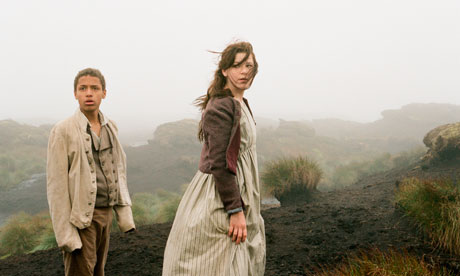
Much has been made in the media of arthouse aficionado Andrea Arnold's decision to depict Heathcliff as a black man in her intensely original adaptation of Emily Bronte's durable classic Wuthering Heights. In truth, this latest version achieves levels of innovation that usually allude adaptations of such well-known novels, not through going back to black with "the dark-skinned gypsy in aspect" but through some other, less-publicised decisions made by Arnold and her co-screenwriter Olivia Hetreed. This film is as preoccupied with Heathcliff and his adoptive sister Cathy Earnshaw in their adolescence as in their adulthood and investigates with wit, insight and vital energy the formative period of their indestructible and ultimately destructive attachment to each other. As Cathy and Heathcliff wander about on the wild and windy Yorkshire moors, they seek solace in each other, they amuse each other, they excite each other, they delight each other and they awaken in each other feelings of sexual desire, beautifully captured in their youthful intensity.

Arnold employs any number of arthouse flourishes to tell this tale afresh and period drama enthusiasts may find much of 2011's Wuthering Heights objectionable. Bronte's eloquent characters speak little here and when they do, it is with a decidedly contemporary turn of phrase, more "Are you OK?" than "I am Heathcliff!" The film is also unrelenting bleak as it bamboozles the viewer with images of death, decay and destruction although Bronte's Yorkshire was hardly as singing, all dancing to be fair. The characterisation of the grown-up Heathcliff is radical, opting for a psychologically astute meditation on cruelty and personal responsibility. How else will a man, who was savagely branded on his back as a slave during childhood and mercilessly beaten for the colour of his skin, react when confronted with thwarted ambitions but savagely and mercilessly?

For all its merits, Wuthering Heights tries too much to feel contemporary and ultimately undermines certain key aspects of Cathy and Heathcliff's story as a result. Cathy's decision, for example, to abandon Heathcliff in favour of another man with better prospects is completely unbelievable in the context of this film and the entire second half featuring the grown-up lovers, who are no longer free-spirited and uninhibited but self-conscious and contained as they take tea in drawing-rooms, sits very uncomfortably with Arnold's hand-held, naturalistic style. The wildness of the first half is so wonderfully served by Shannon Beer and Solomon Glave's earthy performances as the young Cathy and Heathcliff that, despite their best efforts, Kaya Scodelario and James Howson struggle in the drab second half to escape the indelible impression made by their younger counterparts.

Andrea Arnold must be commended for crafting a beautiful film (kudos also to cinematographer Robbie Ryan) with some truly haunting moments (my favourite being a fireside rendition by Young Cathy of the tragic folk ballad of doomed love Barbara Allen eerily foreshadowing the heartbreak and loss to come) and for managing to defamiliarise a classic. However, this new Wuthering Heights is, even on its own terms, often unconvincing.