Friday, November 18, 2011

Young Hearts Run Free


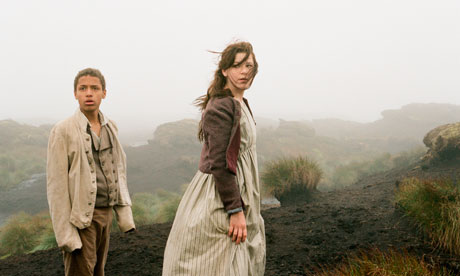
Much has been made in the media of arthouse aficionado Andrea Arnold's decision to depict Heathcliff as a black man in her intensely original adaptation of Emily Bronte's durable classic Wuthering Heights. In truth, this latest version achieves levels of innovation that usually allude adaptations of such well-known novels, not through going back to black with "the dark-skinned gypsy in aspect" but through some other, less-publicised decisions made by Arnold and her co-screenwriter Olivia Hetreed. This film is as preoccupied with Heathcliff and his adoptive sister Cathy Earnshaw in their adolescence as in their adulthood and investigates with wit, insight and vital energy the formative period of their indestructible and ultimately destructive attachment to each other. As Cathy and Heathcliff wander about on the wild and windy Yorkshire moors, they seek solace in each other, they amuse each other, they excite each other, they delight each other and they awaken in each other feelings of sexual desire, beautifully captured in their youthful intensity.

Arnold employs any number of arthouse flourishes to tell this tale afresh and period drama enthusiasts may find much of 2011's Wuthering Heights objectionable. Bronte's eloquent characters speak little here and when they do, it is with a decidedly contemporary turn of phrase, more "Are you OK?" than "I am Heathcliff!" The film is also unrelenting bleak as it bamboozles the viewer with images of death, decay and destruction although Bronte's Yorkshire was hardly as singing, all dancing to be fair. The characterisation of the grown-up Heathcliff is radical, opting for a psychologically astute meditation on cruelty and personal responsibility. How else will a man, who was savagely branded on his back as a slave during childhood and mercilessly beaten for the colour of his skin, react when confronted with thwarted ambitions but savagely and mercilessly?

For all its merits, Wuthering Heights tries too much to feel contemporary and ultimately undermines certain key aspects of Cathy and Heathcliff's story as a result. Cathy's decision, for example, to abandon Heathcliff in favour of another man with better prospects is completely unbelievable in the context of this film and the entire second half featuring the grown-up lovers, who are no longer free-spirited and uninhibited but self-conscious and contained as they take tea in drawing-rooms, sits very uncomfortably with Arnold's hand-held, naturalistic style. The wildness of the first half is so wonderfully served by Shannon Beer and Solomon Glave's earthy performances as the young Cathy and Heathcliff that, despite their best efforts, Kaya Scodelario and James Howson struggle in the drab second half to escape the indelible impression made by their younger counterparts.

Andrea Arnold must be commended for crafting a beautiful film (kudos also to cinematographer Robbie Ryan) with some truly haunting moments (my favourite being a fireside rendition by Young Cathy of the tragic folk ballad of doomed love Barbara Allen eerily foreshadowing the heartbreak and loss to come) and for managing to defamiliarise a classic. However, this new Wuthering Heights is, even on its own terms, often unconvincing.

Tuesday, November 15, 2011

Before The Parade Passes By


Hot on the heels of the announcement that Sir Tom Stoppard is working on a stage adaptation of his Oscar-winning screenplay for Shakespeare in Love is news that the same Sir's passion project of a five-part television miniseries based on Ford Madox Ford's celebrated Parade's End tetralogy is currently filming in London. A co-production between HBO and BBC Two and adapted from Ford's novels Some Do Not, No More Parades, A Man Could Stand Up and Last Post, Parade's End follows the fortunes of English aristocrat and government statistician Christopher Tietjens, his beautiful but wilful socialite wife Sylvia and Valentine Wannop, a young suffragette with whom he falls in love, from the twilight years of the Edwardian era to the end of the First World War. Downton Abbey goes to town, perhaps?

Stiff upper lip maestros Benedict Cumberbatch and Rebecca Hall are playing Christopher and Sylvia and are joined by young Australian actress Adelaide Clemens as Valentine and a stellar supporting cast including Geoffrey Palmer, Jack Huston, Claire Higgins, Freddie Fox, Miranda Richardson, Stephen Graham, Roger Allam, Rupert Everett, Jamie Parker, Steven Robertson, Janet McTeer and Anne-Marie Duff, I do hope Miss Duff is having as much fun on set with fellow Terence Rattigan enthusiast Benedict Cumberbatch as she is having in the above still on stage in London in Rattigan's Cause Celebre earlier this year. Parade's End is being directed by by period drama stalwart Susanna White (2005's Bleak House and 2006's Jane Eyre are amongst her credits), returning to television after last year's Nanny McPhee and the Big Bang. One suspects that Parade's End will feature more scenes of muddy trenches and less scenes of pigs synchronised swimming. We'll see!

Friday, November 11, 2011

Seeing Double


The old saying about waiting a lifetime for a bus to come along only for two to come along at once does not just apply to public transport, it seems, but increasingly to period dramas also. Above is a newly-released picture of Helena Bonham Carter as Miss Havisham in Mike Newell's Great Expectations movie which is currently filming in London from a script by One Day's David Nicholls. The film looks set to be a lavish affair and will also feature Bonham Carter's Harry Potter co-stars Ralph Fiennes as Abel Magwitch, Robbie Coltrane as Mr Jaggers and Jessie Cave (the late Lavender Brown) as Biddy alongside War Horse's Jeremy Irvine as Pip and The Borgias's Holliday Grainger as Estella. The supporting cast also includes Jason Flemying as Joe Gargery, Sally Hawkins as Mrs Joe, Olly Alexander as Herbert Pocket, Ewen Bremner as Wemmick and Tamzin Outhwaite as Molly. As previously reported on this blog, Gillian Anderson will appear as the jilted lady of Satis House alongside another all-star cast in the BBC's latest three-part adaptation of the Dickens favourite this Christmas and will become the youngest actress to have played the role, narrowly beating the Bonham Carter by two years.


The latest Great Expectations adaptations will bookend a year of celebrations marking two hundred years since Charles Dickens first shuffled onto this mortal coil. 2012 also marks the centenary of the sinking of the RMS Titanic in April 1912 and two television series will chronicle the life and times of the doomed luxury liner. As Maria Doyle Kennedy told me back in September, ITV's Titanic is written by Julian Fellowes will feature his characteristic multi-character storytelling and span the social spectrum with a mixture of fictional and real-life passengers. Titanic: Blood and Steel, an Italian/Irish co-production currently filming in Dublin, takes an altogether different approach spanning the socially tumultuous fifteen-year period from 1897 to 1912 in which the ship was conceived, designed and built and Belfast. The international cast features Neve Campbell, Martin McCann, Kate O Toole, Kevin Zegers, Sir Derek Jacobi, Gray O Brien, Charlotte Bradley and Sex and the City's Mr Big, Chris Noth alongside Liam Cunningham and Joely Richardson as legendary politicians and trade-union activists Jim Larkin and Countess Markievicz. Given that Titanic: Blood and Steel leaves off where Titanic begins, perhaps the series will compliment each other nicely when they surface in the spring.

Monday, November 7, 2011

There Is A War On, You Know!


The second series of the hugely successful period drama Downton Abbey, which finished last night on ITV, strove earnestly to depict the horrors and hardship of life in Britain and on the battlefields during the Great War of 1914 to 1918. The most conspicuous wartime struggle was, however, that of series creator and writer Julian Fellowes and the creative team behind Downton who never quite managed to achieve the balance between being informative about a fascinating period of history and being hugely entertaining, a balance which greatly contributed to the resounding success of series one.

This year's episodes were so cluttered with white feathers, court marshals, shell shock, food rationing, conscription, convalescence, disfigurements, bereavements, widows' pensions and ladies working the land that few stories had sufficient time to develop satisfactorily and many remained unengaging. And although the trenches were impressively re-created, the scenes on the Somme ultimately seemed rather redundant as the most effective moments were those back at the Abbey with the various much-loved characters coming to terms with what the war had done to them.

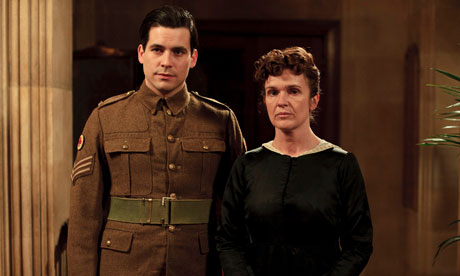
All in all, the second series of Downton Abbey was afflicted with such a bad case of Difficult Second Season Syndrome that not even the collective powers of Major Clarkson, Nurse Crawley Mrs Crawley and Corporal Barrow could have seen it right. Much like poor traumatised Mr Lang, it tried to do too much too soon and unable to cope with the weight of responsibility, bungled about rather hopelessly allowing only occasional glimpses of its vast capabilities. Some many have sniggered in the corner, as above. Thanks heavens for the millions of Lavinia Swires the world over who were willing to patiently and lovingly see it through its worst bouts of incompetent pacing, jarring characterisation and tedious predictability to something resembling its past glory.

Promisingly, last night's series finale was rather excellent and satisfying viewing for those who have been kept waiting a great deal too long for the resolution of will-they-won't-they romances between Bates and Anna, Sybil and Branson and Cousin Matthew and Lady Mary. Much was left to be settled and here's hoping it will be settled not with more plot developments that lack conviction (did anyone buy into the supposed estrangement between Lord and Lady Grantham?) but with more beautifully judged moments of heartbreak and loss (deathbeds become Downton, they really do!) and many more moments with the Dowager Countess grappling to come to terms with modern technology.

Wednesday, October 26, 2011

A Return from the Shadows


Guy Ritchie is currently in post production on the sequel to his 2009 box-office smash hit Sherlock Holmes. Daft as a brush but rollicking good fun nonetheless, the movie garnered much critical acclaim for Robert Downey Jr's robust comic turn as Arthur Conan Doyle's iconic detective. Somewhat of an action hero in Ritchie and Downey Jr's hand, this was indeed Holmes as he had never been seen before. Downey Jr was joined by Jude Law as his beleaguered sidekick Dr Watson and both actors will reprise their roles in Sherlock Holmes: A Game of Shadows alongside The Girl with the Dragon Tattoo herself, Swedish actress Noomi Rapace as mysterious medium Sim. Aren't they always mysterious, these movie mediums? The trio (pictured above) face off against Holmes's great nemesis, only alluded to in the first film, Moriarty, played by Jared Harris. Another new face, Stephen Fry as Holmes's sharp-as-a-tack big brother Mycroft, will feature alongside returnees Kelly Reilly as Watson's fiancee Mary, Eddie Marsan as Inspector Lestrade of Scotland Yard, Geraldine James as landlady Mrs Hudson and Rachel McAdams as femme fatale Irene Adler.


Judging by the trailer, A Game of Shadows will no doubt be another action-packed romp. The shenanigans on a train look particularly intriguing. The first film just about succeeded but one hopes that story is not sacrificed on the altar of CGI spectacle when the sequel opens in cinemas around the world just before Christmas. Meanwhile, Mark Gatiss and Steven Moffat's modern-day re-imagining of Sherlock Holmes, the BBC's Sherlock, will follow hard on its heels in the New Year with adaptations of three of most famous Sherlock stories, The Reichenbach Fall, The Hound of the Baskervilles and A Scandal in Bohemia. The ingenious series, starring Benedict Cumberbatch as Holmes, Martin Freeman as Dr Watson, Rupert Graves as Inspector Lestrade, Una Stubbs as Mrs Hudson, Gatiss as Mycroft, Andrew Scott as Moriarty and Lara Pulver as Irene Adler, is in many ways closer to the spirit of the original creation than the Hollywood version, despite the latter's lavish Victorian sets.


Lavish Victorian sets are currently under construction by the BBC for their recently-announced eight-part drama series Ripper Street. Taking place in 1889, the intense drama will examine life in Whitechapel in the aftermath of the horrific crimes committed by one Jack the Ripper. Written by Richard Warlow of Waking the Dead fame, Ripper Street explores the lives of characters trying to recover from the Ripper's legacy, from crimes that have not only irretrievably altered their lives, but the very fabric of their city. At the drama's heart, detectives from the notorious H Division - the police precinct from hell, by all accounts - try to bring a little light into the dark world they inhabit. One suspects that it will not occupy the time slot vacated by the recently-axed Lark Rise to Candleford when it hits our screens next year. Just a hunch!

Thursday, October 20, 2011

Heaven Knows Anne's Miserable Now


In the above still are Hugh Jackman and Anne Hathaway singing to each other as David Frost and Richard Nixon in a Frost/Nixon sketch at the 2009 Academy Awards. It seems that Jackman and Hathaway will soon be singing together again but in a much less light-hearted manner in the long-awaited movie adaptation of Boubil and Schonberg's musical mega-hit Les Miserables, based on the classic French novel by Victor Hugo. It was this week confirmed that Hathaway has signed on to appear as down-on-her-luck factory worker Fantine alongside Jackman as one-time convict, now respectable factory owner and mayor Jean Valjean who takes pity of her and poignantly promises her on her deathbed to rescue her daughter from the cruel Thernadiers and care for her as though she was his own. He is thwarted at every turn, however, by obsessive police chief Javert who refuses to forget the past and accept that Valjean is a reformed character. Both Javert and Valjean also become embroiled in political instability in nineteenth-century Paris as a group of idealistic students mount barricades and fight for the emancipation of the Proletariat, all the while singing some lovely songs it has to be said.

After much speculation, Russell Crowe has been announced as Jackman's dogged pursuer. The only other confirmed cast member at this stage is Helena Bonham Carter as the thoroughly unpleasant Madame Thernadier. Bonham Carter's Alice in Wonderland co-star Hathaway will sing the iconic I Dreamed a Dream in the movie to be directed by The King Speech's Tom Hooper. Theatre impresario Cameron Mackintosh will produce the film version of the musical that he first staged twenty-six years ago to a critical thrashing. It subsequently transpired that misery loves company and it has been running in London and in various locations around the globe ever since. The truth is, however, that other long-delayed movie versions of musical classics such as Evita and The Phantom of the Opera have underperformed significantly. Hooper, based on the evidence of The King's Speech, seems a good choice of director to me as any adaptation of Les Miserables will have to successfully intertwine the epic moments of public outrage and defiance with the more intimate moments of personal heartbreak and sacrifice. We can all hear the people sing and judge for ourselves when Les Miserables is released in cinemas on 7th December 2012.

Charles Dickens: A Comedy Roast


Plans to celebrate the bi-centenary of Charles Dickens's birth next year continue apace at the British Broadcasting Corporation. Following announcements of new adaptations of Great Expectations and The Mystery of Edwin Drood, BBC Radio 4's acclaimed comedy series inspired by the many novels of the great man, Bleak Expectations, is to be adapted for television this Christmas as The Bleak Old Shop of Stuff by writer Mark Evans. It seems to me very fitting that such a project be greenlit at a time when we reflect on Dickens's vast contribution as he himself was an merciless satirist of various aspects of Victorian life and one would like to think that he would be able to appreciate a well-made parody of the various tropes and conventions of his own oevure. The series, beginning with a Christmas special and continuing with three further episodes in the New Year, will no doubt feature youthful indiscretions, unscrupulous individuals with flamboyant names, selfish parents, patient wives and many a reversal of fortune.

The Bleak Old Shop of Stuff tells the tale of one Jedrington Secret-Past, the up-standing family man and owner of The Old Shop of Stuff, Victorian London's most successful purveyor of miscellaneous odd things. We will follow Jedrington's various misadventures including being incarcerated by the evil lawyer Malifax Skulkingworm in London's infamous prison The Skint on the eve of Christmas until he can repay a mysterious and vast debt, teaming up with seemingly charming business partner Harmswell Grimstone and discovering that his wife Conceptiva has a secret past that is even darker than his own. Starring Robert Webb as Jedrington, Katherine Parkinson as Conceptiva, Stephen Fry as Skulkingworm and Tim McInnerney as Grimstone, the impressive ensemble cast also includes David Mitchell (pictured above with comedy partner Webb in a Poirot skit from their sketch series), Sarah Hadland, Celia Imrie, Pauline McLynn, Kevin Eldon, Derek Griffiths and Johnny Vegas. What larks, eh?